Staying Poised at a Gala Dinner: My Etiquette Lessons

Reading time: 8 minutes
When the invitation to the charity gala dinner at Lincoln Center lit up my phone, I swung between excitement and panic. My sugar daddy had booked me as his companion for the evening: $350 per ticket, dress code "black tie," starting at 7 p.m. I had already attended elegant dinners at Michelin-starred restaurants in New York, but a real gala dinner with 200 guests from business, politics and high society was new territory. The gala dinner etiquette I had only known from movies until then was about to put me to the test that evening.
Today, three years and countless formal events later, I can look back and honestly say: that first evening was one big learning experience. I made mistakes, muddled through, and in the process understood that poise at occasions like this has less to do with perfection than with observation and common sense. In this article I share my most important insights on gala dinner etiquette so you don't make the same beginner mistakes at your first high society event.
Preparation: dress code and first research
Three weeks before the event I stood in front of my closet and realized: I didn't own a single evening gown that met the "black tie" dress code. So I researched what that even means. Black tie for women means floor-length or just above the ankle, elegant, usually in muted colors, no sequin excess. I invested in a simple dark green silk dress from a small couture boutique on Madison Avenue, paired with understated stud earrings and a clutch. Budget: around $900, which my companion generously reimbursed later.
What I underestimated at the time: the right clothing is only half the battle. I should have researched the occasion more beforehand. Was it a charity event? For which organization? Who was sitting at the table? Details like these help enormously with small talk and show genuine interest. The next time, I googled the guest list beforehand and read up on the topic.
Arrival and small talk: the first 30 minutes decide
We arrived right on time at 7:15 p.m. The view over the plaza was breathtaking, the lobby full of people in tuxedos and evening gowns. Here I made my first mistake: I clung to my companion instead of confidently entering the room. At high society events the rule is: you may lean on someone, but you may not hide.
The champagne reception lasted about 45 minutes, and I quickly learned that small talk at occasions like this follows its own rules. You talk about neutral topics like travel, art and current cultural events, never politics, religion or money. When a woman asked what I do for a living, I answered evasively with "I'm studying communications and work part-time in marketing." Truthful, but discreet enough. You'll find more on communication in such arrangements in my article about difficult conversations in sugar dating.
A tip I only internalized later: always introduce the person of lower rank to the person of higher rank. So: "Mr. Miller, may I introduce Ms. Smith?" and not the other way around. It shows respect for hierarchies that still play a role in these circles.
At the table: silverware, glasses and the invisible rules
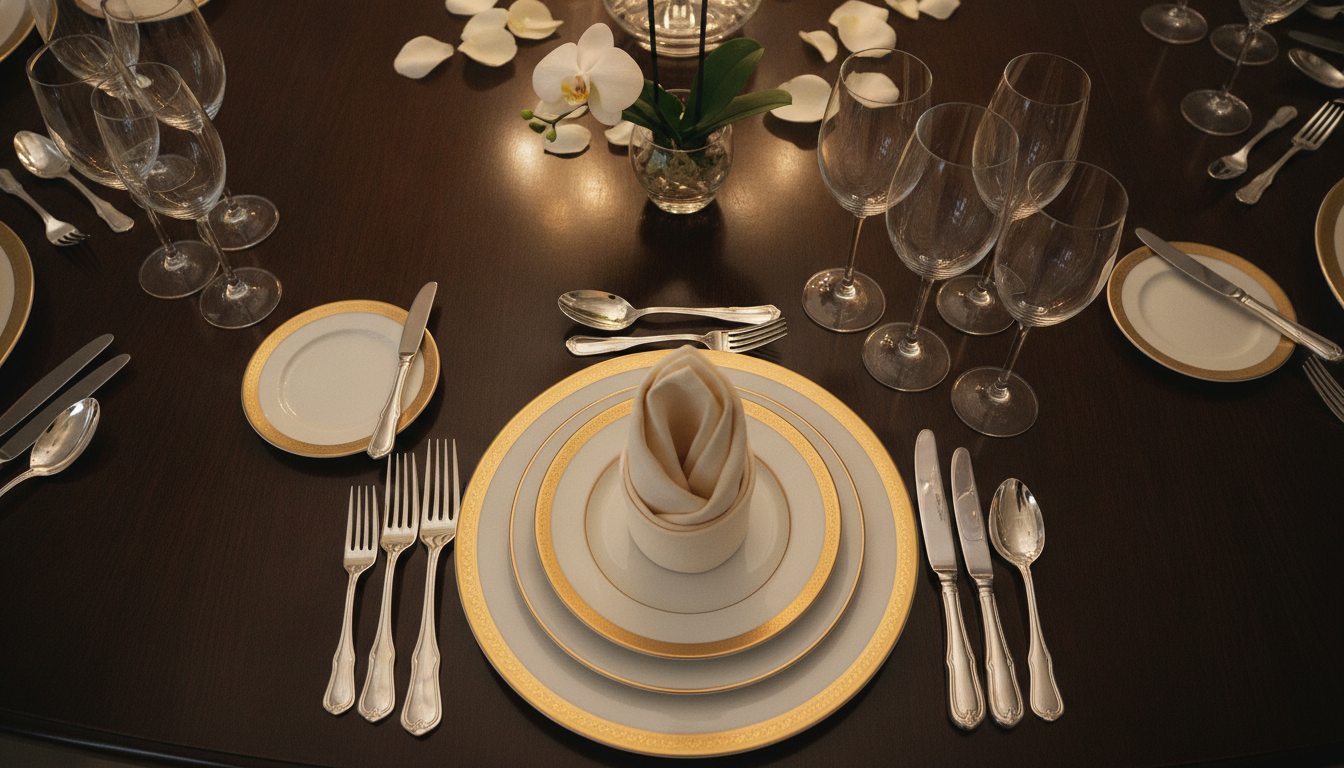
When we were asked to take our seats, I stood in front of a place setting with four forks, three knives, two spoons and what felt like a dozen glasses. Panic. I remembered the golden rule: work from the outside in. The outermost silverware is for the first course, the innermost for the main course. Sounds simple, but in a moment of uncertainty it's easy to forget.
Here are the most important table manners, elegantly executed, that I learned that evening:
- Put the napkin on your lap right away as soon as you sit down, never tuck it into your neckline
- Break bread by hand rather than cutting it, and butter each piece individually
- Move the soup spoon away from you, not toward you
- When pausing, cross your silverware on the plate; when finished, lay it parallel in the 4:20 position
- Hold the wine glass by the stem, never the bowl, to avoid fingerprints and warming
- Never put your phone on the table or check it during the meal
The menu consisted of five courses: amuse-bouche, appetizer, intermediate course, main course, dessert. Each course was accompanied by a different wine. I drank little, sipped politely, stayed clear-headed. That was a conscious decision and has proven itself. At events like these you want to observe, learn, be present.
The most embarrassing moment: when I took the wrong glass
Between the appetizer and the intermediate course I reached for the white wine glass of my neighbor on the right because I had lost my bearings. He smiled charmingly, didn't correct me directly, but demonstratively picked up his own glass. I realized the mistake, apologized quietly and learned: glasses are on the right, bread on the left. Drinks right, bread left. That mnemonic saved me at every dinner after that.
Conversation at the table: who talks to whom?
In formal gala dinner etiquette, you speak alternately with your left and right table neighbors, not across the table. In the first half of the dinner (until the main course) you turn to your right neighbor, after that to your left. This is called "switching dinner partners" and ensures nobody sits isolated.
I sat to the right of an entrepreneur from Boston and to the left of an arts manager. Both were polite, asked questions, and I tried to answer authentically without revealing too much. Topics that worked well: my studies, travel plans, the architecture of the venue, current exhibitions in New York. What I avoided: details about my private life, my family, my financial situation.
An important point I took away from that evening: you don't have to know everything or be perfect. Honest interest, open questions and active listening make more of an impression than stilted shop talk.
After dinner: networking without being pushy
After dessert and the hosts' words of thanks, the company slowly dispersed. Some guests stayed at the bar, others said their goodbyes. My companion led me to two or three people he knew, introduced me, and I politely exchanged small talk. Business cards were not exchanged; that would have been too businesslike for this setting.
What I learned from this: luxury events are also networking opportunities, but subtle ones. You leave an impression, not a sales pitch. You show interest without seeming pushy. And you respect that not every contact has to lead to a relationship.
If you'd like to learn more about events like these, I recommend my post about an evening at an exclusive private club, where similar rules apply.
What I would do differently today

Looking back, I could have prepared better. An etiquette course, or at least a YouTube tutorial on table manners, would have spared me a lot of uncertainty. I should have researched the organization the gala dinner was held for, and I could have been bolder in small talk.
At the same time I'm grateful for the mistakes I made. They taught me that perfection is not the goal. Poise comes from recognizing mistakes, learning from them and appearing more confident next time. Today I enter events like this with a mix of respect and calm. I know how to move, how to speak, how to eat, but I also know that a smile and genuine interest often count for more than perfect gala dinner manners.
Frequently asked questions about gala dinner etiquette
What do you wear to a gala dinner?
For "black tie" you wear a floor-length or ankle-length evening gown in muted colors, combined with understated jewelry and an elegant clutch. Men wear a tuxedo with a bow tie, no necktie. "White tie" (rarer) calls for tailcoats, and for women an even more formal dress code with long gloves.
How do I behave properly at a gala dinner?
Arrive on time, put the napkin on your lap right away, work your silverware from the outside in, speak alternately with your left and right table neighbors, and avoid phones, loud voices and controversial topics. Politeness, restraint and attentiveness are your best companions.
What topics suit small talk at high society events?
Safe topics are travel, culture, architecture, current exhibitions, theater, music and general social developments. Taboo are politics, religion, money, illness and private problems. Keep the tone light, positive and inclusive.
How do I handle uncertainty about table manners?
Discreetly observe the guests around you, take your cue from the host and use the basic rule "outside in" for silverware. When in doubt: better to eat a bit more slowly and wait than to reach for the wrong utensil too quickly. Nobody expects perfection, but everyone appreciates effort.
How long do you stay after the meal at a gala dinner?
After dessert and the words of thanks you can stay another 30 to 60 minutes to network and make small talk. But don't leave the event before the host or the guest of honor. A polite goodbye to the organizer is part of it, without imposing for long.
Conclusion: etiquette can be learned, poise comes with practice
My first gala dinner at Lincoln Center was no disaster, but not a perfect performance either. I learned that gala dinner etiquette isn't there to exclude people but to give all guests a common framework. The rules of gala dinner conduct are not as rigid as I feared, and most people forgive small mistakes as long as you stay authentic and respectful.
If you're preparing for your first formal event: inform yourself beforehand, invest in the right clothing, observe attentively and stay yourself. Don't pretend, but show respect for the setting. And if you're unsure how to behave in your arrangement, it helps to set clear boundaries beforehand and communicate openly about what you expect and what you don't.
Today I look forward to events like these. They are an opportunity to dive into a world that used to be foreign to me, meet interesting people and develop myself. Gala dinner etiquette is no longer an obstacle but a tool that helps me appear poised and confident. And most importantly: I've learned that you don't have to be perfect to belong; you just have to be willing to learn and adapt.